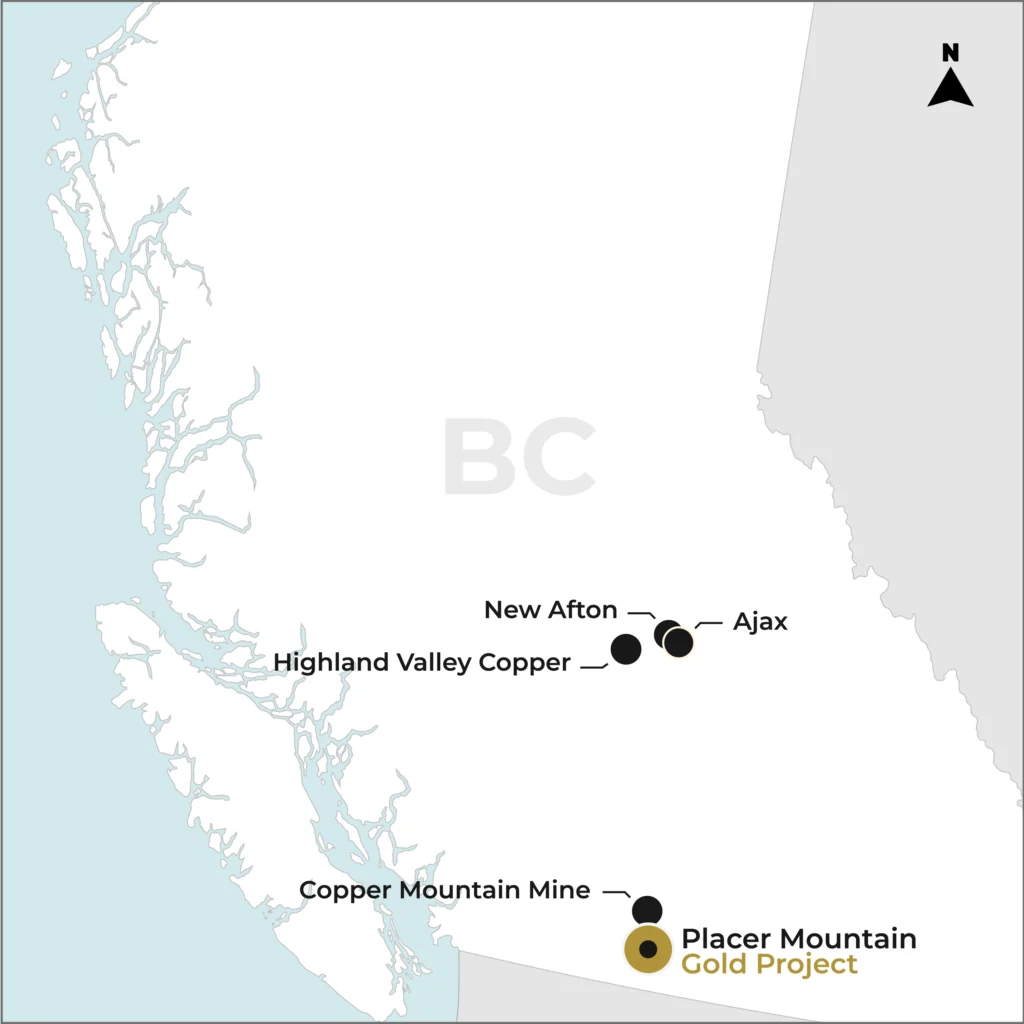
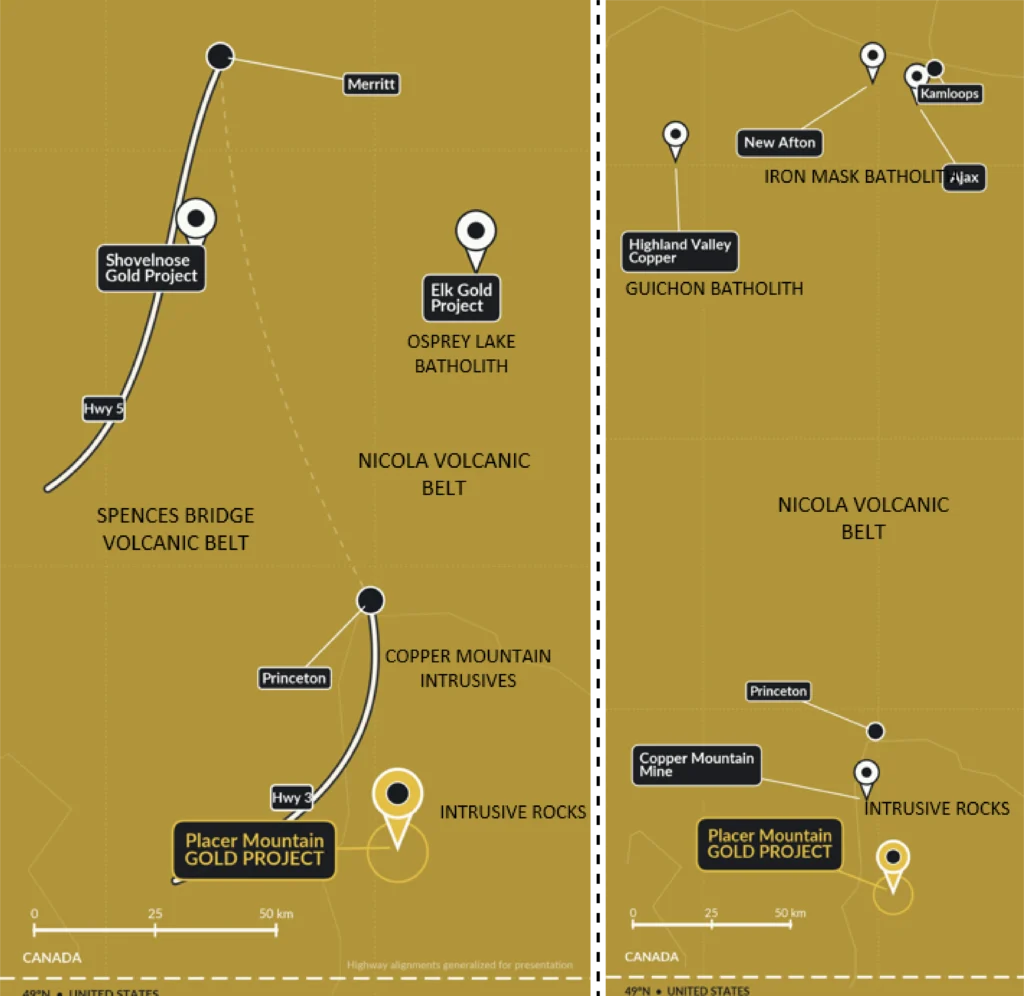
Three producing mines: New Afton, Highland Valley, Copper Mountain
Established mining corridor with active production
Large scale infrastructure, multiple targets
Promising Geological Setting
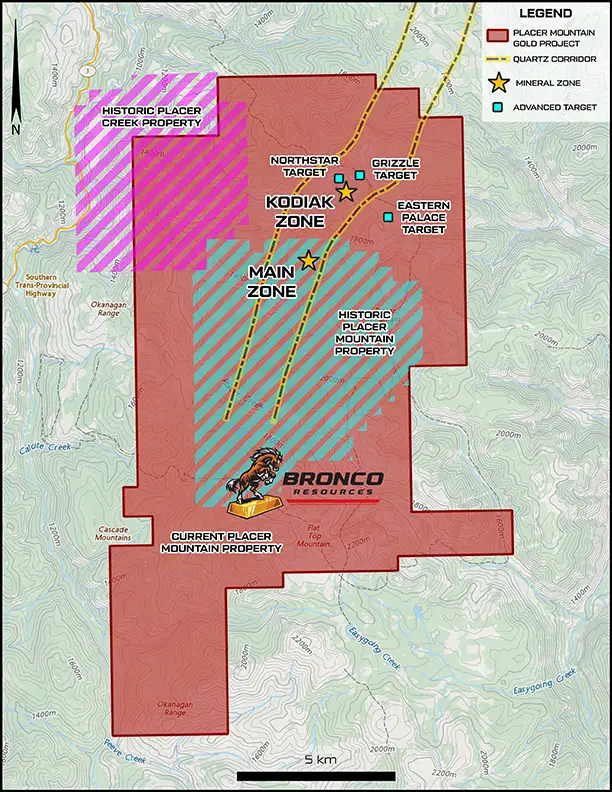
The property has significant potential to host a large-scale orogenic gold system, with the Kodiak and Main Zones situated 2.5 km apart along a geological contact between the Nicola Group and granitic intrusions. This setting is comparable to the Elk Gold Project, a past producer located approximately 70 km north, which hosts mesothermal gold veins in a similar geological environment. The region is also home to established mines, including New Afton, Copper Mountain and HVC.
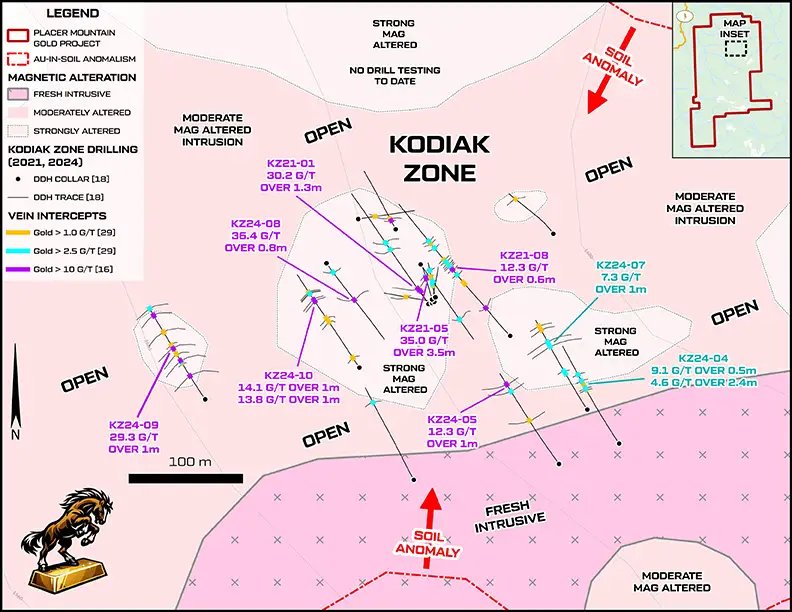
2024 | Kodiak Zone Phase 2 Drilling Expands High-Grade Gold
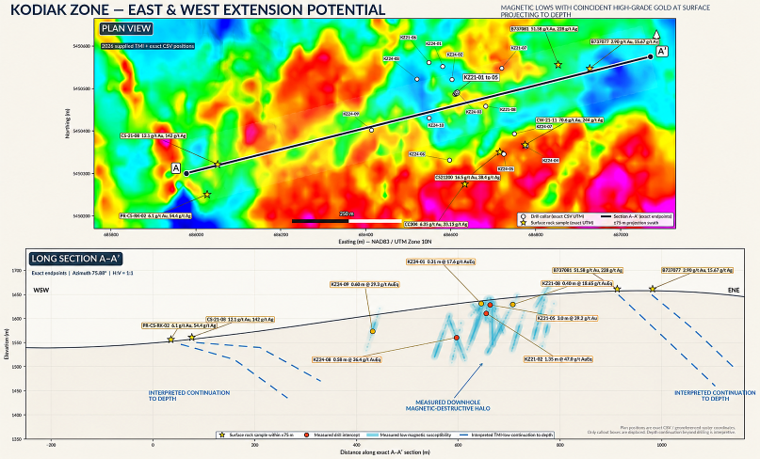
The 2024 Phase 2 drilling program extended high-grade gold mineralization along strike, with all 10 diamond drill holes intersecting gold and the mineralized footprint expanding to approximately 300 × 300 m. Results included 0.80 m at 36.40 g/t Au and 13.10 m at 2.28 g/t Au. Despite strong results, limited structural data, core orientation and geophysical targeting left significant opportunities to refine the geological model and guide future exploration.
2026 | A New Paradigm: Building the Exploration Model
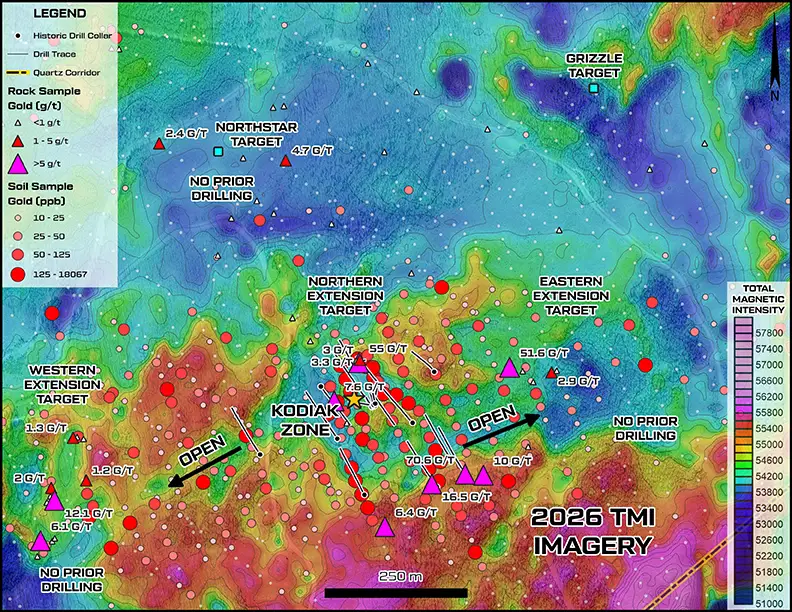
Bronco completed 450 line-km of high-resolution ground magnetics and re-evaluated 1,961 m of historic drill core, identifying distinct mineralization styles. The results differentiated magnetite-rich mineralization from later, weakly magnetic gold associated with quartz veining and chalcopyrite, creating a refined framework for future exploration targeting.
Magnetic Phase (I)
9.11 g/t Au
Strong magnetic response
Interstitial black magnetite
143 x 10-3 K SI response
Non-Magnetic Phase (II)
17.60 g/t Au
Weak magnetic response
Chalcopyrite (Cu) bearing phase
0.05 - 0.25 x 10⁻³ K SI response
New Phase (III)
Blue quartz phase
First recognized in 2026
Lack of sulfide minerals
Very low iron content
51.6 g/t Au east of Kodiak